
SIMOC Mars
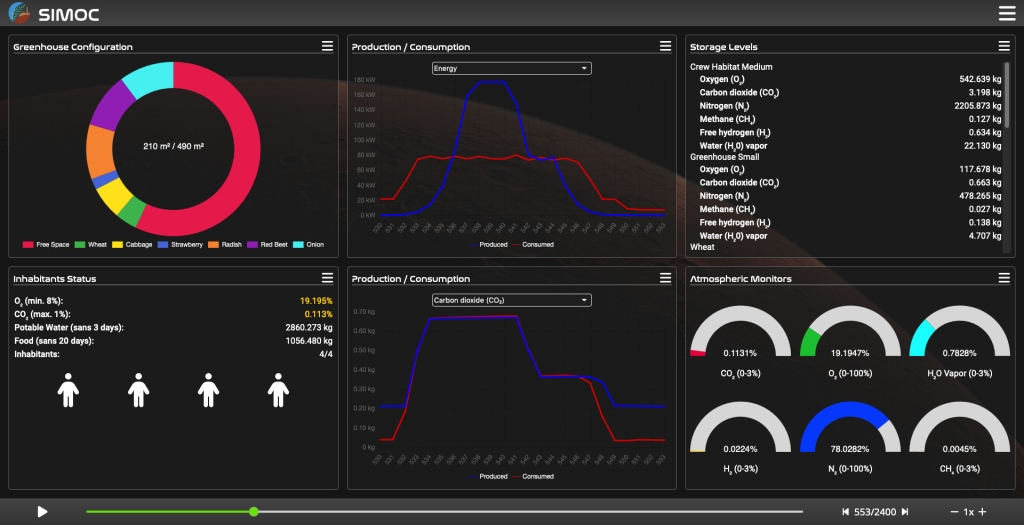
SIMOC is a computer model and simulation of a habitat on Mars. You, the habitat designer, select the size of your habitat, the number of astronauts, food rations and the types and quantity of food cultivars you desire to grow; solar panels, batteries, life support systems, and more. Each of these is an ‘agent’, a unit defined by relatively simple exchange of ‘currencies’ such as oxygen, carbon dioxide, water and water vapor, nutrients, light, and electricity. When set in motion, you will learn if your habitat is a balanced system with ample supplies for immediate and long-term sustainability. If you don’t at first succeed, you can go back to the configuration wizard, adjust the parameters, and try again.
The SIMOC dashboard provides both raw values and graphical representation with option to download your configure and share with others, or export the data for analysis on your personal computer.
In development since 2017, SIMOC began with a dataset built from NASA’s Baseline Values and Assumptions (see resources) document and more than 30 years plant physiology research at NASA Kennedy Space Center. Development continues today with integration of scientific publications and collaboration with colleagues in the aerospace research and development sectors. A growing SIMOC Live userbase provides air quality monitoring data which works to validate and improve the SIMOC model, as with the Space Analog for the Moon & Mars (2022-26).
SIMOC B2
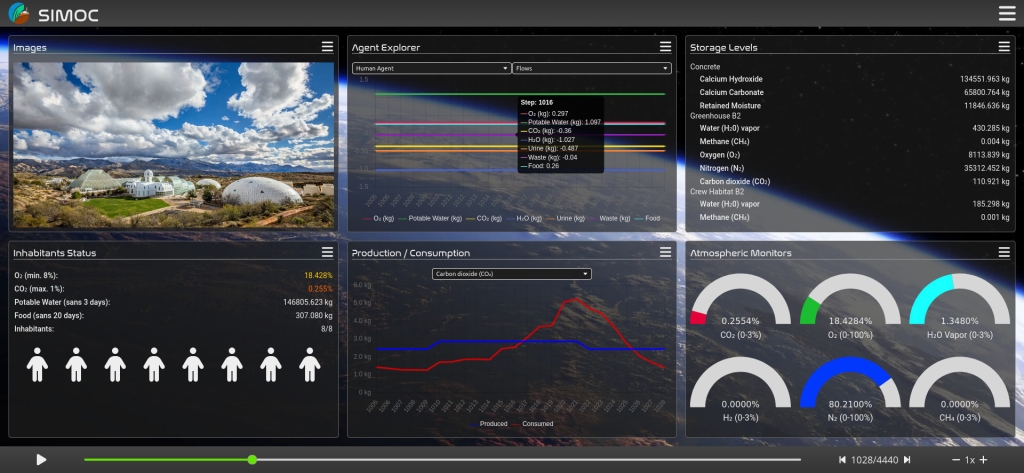
In the summer of 2022 National Geographic Society and Biosphere 2 (B2) jointly funded the development of a new simulation for SIMOC. Lead by developer Grant Hawkins, SIMOC B2 incorporates data and experience from the first (1991-93) and second (1994) B2 sealed missions. By programming agents for each of the B2 biomes (rain forest, ocean, savanna, desert, and agriculture further defined by key food cultivars), concrete, and microbial activity in the rich soil, this model successfully demonstrates how the first mission was challenged by a diminishing oxygen supply.
The second mission learned from the first, modified many of its experimental parameters (e.g. reducing the crew by one, managing the crops in a different manner, covering much of the exposed concrete with a seal) and was able to improve the operational functions. This too is accurately modeled.
Citizen scientists, students, any user can then modify SIMOC’s configuration parameters to experiment with the ratio of the biomes, alter the balance of food cultivars, and reduce the amount of curing concrete. What has too often been called a “failure” (there is no such thing as a failed experiment if something new is discovered) is instead a powerful learning experience, as were the real Biosphere 2 missions!
The simulation of a near-future Mars habitat, the Space Analog for the Moon & Mars (SAM), and Biosphere 2 are integrated into the SIMOC web interface and readily available to you.
First Time User | Advanced User | The Presets for Biosphere 2
SIMOC Kiosk
The SIMOC Kiosk mode is built-in to every installation and activated by a key-stroke. The “kiosk” mode offers full-screen, no keyboard entry for guided or unguided learning in a public space. The Arizona Science Center, Phoenix, has installed an interactive SIMOC exhibit on their technology engagement floor, and is the world’s first science center to bring SIMOC to its visiting citizen scientists. Learn more …
To bring SIMOC to your science center, please contact us.