Research & Development

ASU CS Capstone help design SAM data services

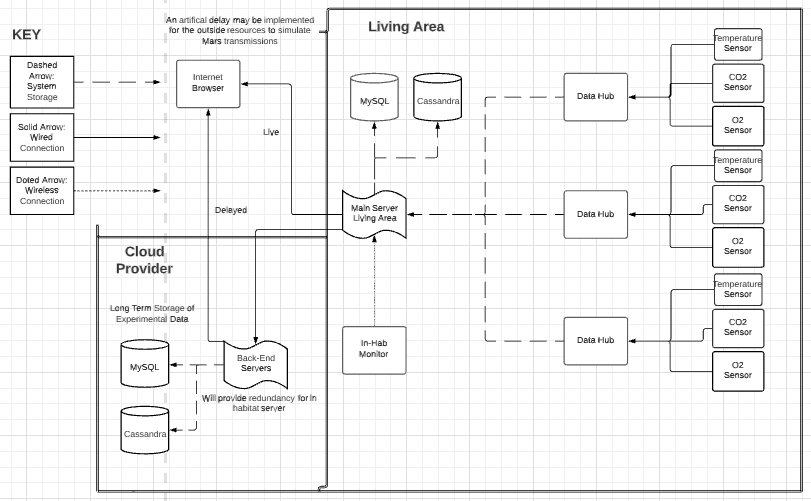
ASU CS Capstone team generates draft SAM sensor array for SIMOC

Initiated in early October, the Arizona State University undergraduate Computer Science Capstone team, in concert with Ezio, Grant, and Kai of the SIMOC development team have completed a second-draft work-flow for the sensor array to be embedded in the Space Analog for the Moon and Mars (SAM) at Biosphere 2.

This design will continue to evolve as SAM is constructed and the SIMOC team dives into real-world sensor tests in place of the current SIMOC simulated data. Stay tuned!

By |2022-01-16T06:18:21-07:00October 31st, 2021|Categories: Research & Development|0 Comments

3D view of habitat added to Wizard, Dashboard

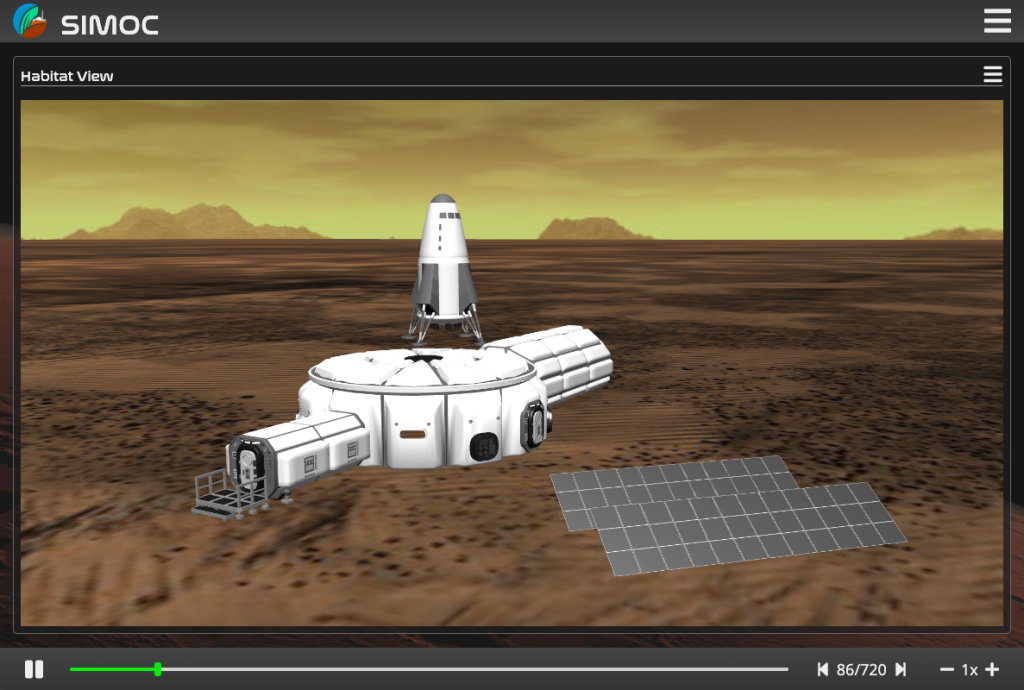
Screenshot of the new 3D interface to SIMOC

The SIMOC development team has added the long-awaited 3D view of the habitat, available to the user both while configuring the habitat and on the SIMOC simulation dashboard. Users enjoy a dynamic visual representation of the habitat provided by space architecture designer Bryan Versteeg of SpaceHabs, such that as they select varied sizes of the habitat components, the image updates.

By |2022-01-16T06:55:24-07:00September 13th, 2021|Categories: Research & Development|0 Comments

Arizona State University Computer Science Capstone team joins SIMOC!

We are pleased to welcome David Wingar, Gregory Ross, Ian Castellanos, Meredith Greythorne, and Ryan Meneses to the SIMOC team for the next nine months. They will be working with SIMOC developers Ezio Melotti and Grant Hawkins to build a new back-end to the SIMOC web interface, providing a live data feed from the array of sensors in SAM, the hi-fidelity Mars habitat analog being constructed at the Biosphere 2.

By |2021-10-04T18:59:18-07:00September 7th, 2021|Categories: Research & Development|0 Comments

Moving into Phase V of SIMOC development

As the SIMOC team transitions from Phase IV into Phase V development, we are shifting design and coding gears from a year spent principally in improving the scalability and stability of the SIMOC deployment across Google Cloud Platform coupled with several improvements to the user interface, back into an effort to more closely define the agent interactions, improving their real-world representation.

Learn more

By |2021-06-02T22:57:21-07:00June 2nd, 2021|Categories: Research & Development|0 Comments

SIMOC Phase IVa upgrade live at Nat Geo

SIMOC Phase IV update

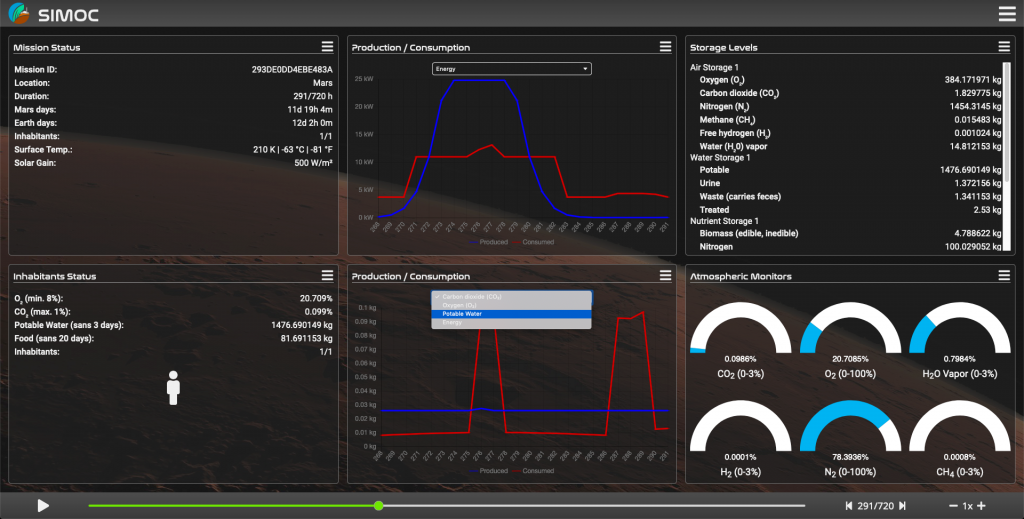
The first of the Phase IV updates to SIMOC is now live at the National Geographic Educational Resource Library. This release marks a return to the evolution of the SIMOC user interface after several months work on an automated build and deployment pipeline by the development team. The current effort is focused on reducing the quantity of dashboard panels where in a single panel will have an inset pull-down menu with multiple options.

Now the Production / Consumption panel can display carbon dioxide, oxygen, water, and energy. Front-end developer Ezio Melotti states, “With the automated build and deployment system in place, we are now able to release SIMOC updates on a regular basis with the confidence of a fully tested environment. This first release lays the foundation for many more to come, soon.”

By |2024-11-21T23:05:07-07:00January 5th, 2021|Categories: Research & Development|0 Comments

Researchers integrate SIMOC into realworld experiments

Researchers Brittany Zimmerman, MSc of the University of North Dakota and Sean Gellenbeck, PhD student of the University of Arizona are each working on advanced plant physiology experiments in which SIMOC is integrated into their research project.

Sean will be growing mushrooms and algae in a closed/sealed environment while at the HI-SEAS analog on the Big Island of Hawaii. His work will introduce a new cultivar to SIMOC. Brittany will be conducting an experiment similar to that of Kai Staats in 2019 at the Biosphere 2. Where Kai and his team monitored CO2, photosynthetic activated radiation (PAR), temperature, relative humidity, and biomass accumulation for barley fodder to give foundation to a non-linear growth function, Brittany will be growing a number of cultivars already contained in the SIMOC model to compare the simulation data to the real experiments.

Both Brittany and Sean will be directly modifying the agent description file for a local installation of SIMOC. This enables them to customize the SIMOC simulation to match the working conditions of their experiments, including volume, air flow, ambient CO2, PAR etc.

We wish them both the best of luck, and are eager to publish the results later in 2021.

By |2021-01-21T16:32:06-07:00December 28th, 2020|Categories: Research & Development|0 Comments

SIMOC Phase IV development update

Our resident coding wizards have completed the arduous task of updating the SIMOC build environment (good things in computer land always take longer than anticipated) and we are ready to get back to making SIMOC a higher fidelity, more engaging experience on Mars for you!

By |2020-10-13T02:31:06-07:00October 12th, 2020|Categories: Research & Development|0 Comments

SIMOC Phase IV development update

Iurii and Ezio have made significant progress on the new build environment for SIMOC. This updated system enables incremental updates to the SIMOC back-end and front-end code base without invoking a full system rebuild, and automated migration to our beta and National Geographic servers. It may not seem like much, but it will make a world of difference to our development process and overall, the quality of our code.

We are excited to dive into an improved user experience, soon!

By |2020-10-13T02:27:56-07:00September 1st, 2020|Categories: Research & Development|0 Comments

SIMOC Phase IV development has begun

We are working hard at constructing a new build environment for SIMOC, enabling automated unit testing and the ability to updates portions of a live build, without replacing the whole thing.

SIMOC Phase IV will include a molecular-level validation of key currency exchanges between agents, consolidation of similar panels with drop-down menus, new panels to provide a greater diversity of real-time information monitoring, and tracking of nutrition from food harvest to human consumption.

More to come, stay tuned!

By |2020-09-01T23:22:33-07:00August 1st, 2020|Categories: Research & Development|0 Comments

At long last …

In the first half of 2020, the SIMOC development team has worked tirelessly to design, develop, rebuild, and test what has become a robust, engaging simulator for the complex interactions of isolated, off-world living.

We are eager to share with you the fruition of our labor in just twelve hours …

By |2020-06-01T05:39:27-07:00May 31st, 2020|Categories: Research & Development|0 Comments
Go to Top